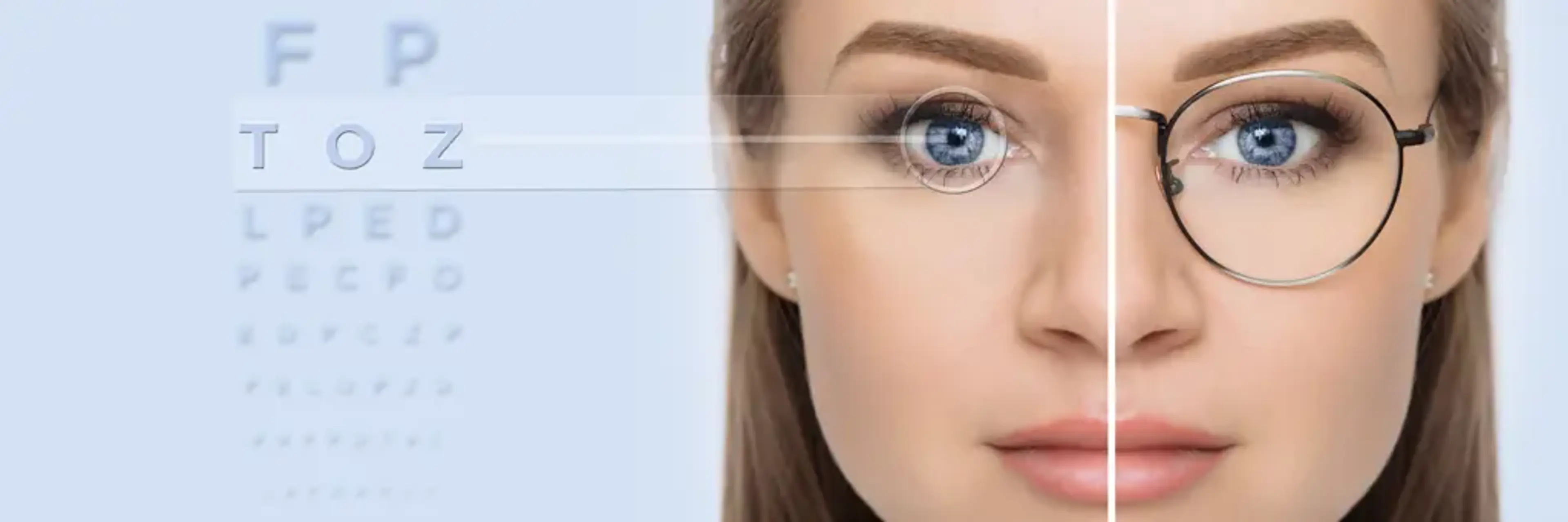
Introduction

what-does-astigmatism-look-like-visualizing-blurred-vision

For many people, the realization that they have astigmatism doesn't happen in a doctor's office. It happens during a night drive. You are behind the wheel, and you notice that the traffic lights aren't crisp circles. Instead, they have long, streaky lines of light bleeding out from the center almost like exploding starbursts. You might turn to your passenger and ask, Doesn't everyone see the lights like that?

The reality is that astigmatism isn't just blurry vision in the way we usually think of it. It is a specific type of visual distortion that can make the world look smeared, shadowed, or tilted. Because many people are born with it they often assume their version of the world is normal.

This guide is designed to help you visualize exactly what this condition looks like through an astigmatic lens. We will also explore how modern technology particularly in global medical hubs like South Korea can fix these distortions permanently and affordably.

Visualizing the Blur: 3 Real-World Scenarios

2.-visualizing-the-blur:-3-real-world-scenarios

To understand this condition, we have to look past simple blurriness. Astigmatism affects how your eye stretches light. Here are three common ways patients experience it:

Scenario A: Night Driving (The Starburst Effect)

scenario-a:-night-driving-(the-starburst-effect)

Nighttime is when the condition is most obvious. Because your pupils dilate (expand) in the dark, more distorted light enters the eye.

  • What it looks like: Instead of seeing a sharp red dot for a brake light, you see smears or halos. Streetlamps appear to have long rays of light stretching vertically or horizontally across your field of vision. This makes it difficult to judge distances between cars.

Scenario B: Reading and Digital Screens (Shadowing)

scenario-b:-reading-and-digital-screens-(shadowing)

When looking at high-contrast objects, like black text on a white screen, the distortion creates a ghosting effect.

  • What it looks like: Letters appear to have a faint duplicate or a shadow right underneath or to the side of them. This can make the text look like it’s vibrating, leading to heavy eye strain after just a few minutes of reading.

Scenario C: Daytime Depth Perception

scenario-c:-daytime-depth-perception

Even in bright light, the world can feel slightly off.

  • What it looks like: Objects at a distance might look slightly tilted or elongated. A rectangular window might look like a trapezoid, or a straight power line might appear to have a slight curve.
Scenario
What Someone with Normal Vision Sees
What Someone with Astigmatism Sees

Night Driving

Crisp points of light

Starbursts, streaks, and glare

Reading

Sharp, black-and-white contrast

Ghosting, double letters, shadows

Distance View

Clear edges and depths

Tilted shapes, soft/smeared edges

The Anatomy of Distortion: Why Does It Look This Way?

3.-the-anatomy-of-distortion:-why-does-it-look-this-way

To understand why your vision is distorted, think of sports equipment. A normal, healthy eye is shaped like a basketball perfectly round. This shape allows light to enter and bend equally from all directions, landing on a single point on your retina.

Astigmatism occurs when the cornea the clear front surface of the eye or the lens inside is shaped more like a football. It has one curve that is steeper than the other.

How Light Bends

how-light-bends

Because the eye is shaped like a football, light doesn't focus on one spot. Instead, light rays hit two different points on the retina. This refractive error is what creates the double images and smears.

Astigmatism vs. Nearsightedness

astigmatism-vs.-nearsightedness

Many people confuse this with being nearsighted. While nearsighted people see a soft blur those with astigmatism see a distorted blur. If you are nearsighted squinting often clears up your vision. However, if you have significant distortion squinting rarely fixes the starbursts or shadows because the brain cannot compensate for the irregular shape of the eye.

Beyond the Visuals: The Silent Symptoms

4.-beyond-the-visuals:-the-"silent"-symptoms

The eyes and the brain are constantly working together. When the eyes provide a distorted image the brain tries to stitch it back together into something readable. This leads to symptoms that have nothing to do with blur:

  • Mental Fatigue: You might feel exhausted after a day of office work, even if you weren't physically active. Your brain is tired from processing ghost images all day.
  • The Squinting Reflex: You may notice chronic tension in your brow. Constant squinting to sharpen the light causes the muscles around your eyes to ache.
  • Recurring Headaches: Many patients suffer from headaches localized right behind the eyes or in the temples. This is often a direct result of untreated visual distortion.

How is it Diagnosed?

5.-how-is-it-diagnosed

If you suspect you have this condition, a standard eye exam will involve three main tests:

  1. The Visual Acuity Test: This is the classic Snellen chart (reading the letters). It determines how much the distortion is affecting your clarity.
  2. Keratometry/Topography: This is a high-tech map of your eye. A computer measures the mountains and valleys of your cornea to see exactly where the football shape is most prominent.
  3. The Autorefractor: You likely remember looking at a picture of a hot air balloon or a small house. This machine automatically measures how light is bending as it enters your eye providing an instant estimate of your prescription.

From Vision to Precision: Correction Options

6.-from-vision-to-precision:-correction-options

The good news is that you don't have to live with starbursts and shadows.

Temporary Fixes

temporary-fixes
  • Toric Lenses: These are specialized contact lenses. Unlike standard lenses, they are weighted at the bottom so they stay in one specific position on your eye without rotating.
  • Specialized Eyeglasses: Lenses can be ground to counteract the specific axis of your distortion.

Permanent Solutions

permanent-solutions
  • LASIK: A laser reshapes the surface of the cornea to make it more spherical.
  • SMILE: Often considered the gold standard for astigmatism, SMILE is a minimally invasive procedure. It uses a tiny keyhole incision to reshape the eye with incredible precision.
  • ICL (Implantable Collamer Lens): If your cornea is too thin for laser surgery, a specialized lens can be implanted inside the eye to provide permanent, crystal-clear vision.

The Cost of Clarity: Why South Korea is the Global Leader

7.-the-cost-of-clarity:-why-south-korea-is-the-global-leader

Correcting astigmatism can be more expensive than correcting simple nearsightedness because it requires more precise technology. In many Western countries, the cost of Toric (astigmatism-correcting) surgery can be prohibitive.

This is why South Korea has emerged as the world’s premier destination for eye surgery. Known as the World Capital of Eye Surgery, South Korea offers a combination of ultra-advanced technology and highly competitive pricing.

Country
Standard LASIK (Per Eye)
SMILE / Advanced Tech (Per Eye)
Medical Standards

South Korea

$800 - $1,300

$1,600 - $2,100

Highest (Global Tier 1)

USA

$2,500 - $3,500

$3,500 - $4,500

High

UK

$2,000 - $3,200

$3,000 - $4,000

High

Canada

$2,200 - $3,000

$3,200 - $4,200

High

Why Travel to South Korea for Treatment?

8.-why-travel-to-south-korea-for-treatment

For international patients, the South Korea Advantage goes beyond just the price tag:

  • Specialized Eye Hospitals: In Seoul, you will find entire multi-story hospitals dedicated exclusively to vision correction. They aren't general clinics they are specialized hubs of excellence.
  • Speed of Care (One-Day Programs): Many top clinics offer One-Day programs. You can have your comprehensive exam in the morning, your consultation at noon, and your surgery in the afternoon perfect for travelers.
  • Advanced AI Diagnostics: Many Korean clinics use AI-guided software to predict exactly how your eye will heal ensuring the highest possible success rate for correcting distortions.

Frequently Asked Questions

faq:-frequently-asked-questions

1. Does Astigmatism Make You See Double?

1.-does-astigmatism-make-you-see-double

Astigmatism can cause a form of double vision known as monocular diplopia. This often appears as a faint ghost image or shadow trailing off an object and can occur even when one eye is closed.

2. Is Astigmatism a Sign of Eye Disease?

2.-is-astigmatism-a-sign-of-eye-disease

In most cases, astigmatism is not a sign of eye disease. It is a common refractive error related to the shape of the cornea or lens. However, sudden or significant changes in astigmatism should be evaluated by an eye doctor to rule out rare conditions such as keratoconus.

3. Can I Wear Normal Contact Lenses With Astigmatism?

3.-can-i-wear-normal-contact-lenses-with-astigmatism

Standard contact lenses are not suitable for correcting astigmatism because they are spherical. People with astigmatism usually need toric lenses, which are specially designed to align properly on the eye and remain stable without rotating.

4. Will My Astigmatism Get Worse Over Time?

4.-will-my-astigmatism-get-worse-over-time

Astigmatism may change slightly with age, but it often stabilizes in adulthood. It does not spread or cause blindness. However, symptoms such as eye strain or headaches may become more noticeable over time if the condition is not properly corrected.

5. Why Is Surgery in South Korea So Much Cheaper Than the Other Countries?

5.-why-is-surgery-in-south-korea-so-much-cheaper-than-the-us

South Korea’s lower surgical costs are due to a highly developed medical tourism system and a large volume of both local and international patients. This competitive environment drives prices down while maintaining and often exceeding Western medical standards.

6. Can LASIK Actually Fix the Starburst Lights at Night?

6.-can-lasik-actually-fix-the-starburst-lights-at-night

Yes, LASIK can significantly reduce or eliminate starbursts and glare at night. By smoothing the irregular curves of the cornea the laser helps light focus more accurately on a single point improving overall night vision quality.

Conclusion

9.-conclusion:-don't-settle-for-smears-of-light

Living with astigmatism is like looking at the world through a window that has been streaked with rain. It affects your safety while driving at night and your productivity during the day.
You don't have to settle for starbursts and headaches. With modern advancements in SMILE and LASIK and the accessible, world-class care found in South Korea perfectly round basketball-shaped vision is within reach. Consult a specialist today to see if you are a candidate for permanent correction.